Commercial Boiler Repair That Restores Heat and Protects Your Operation
A commercial boiler that loses pressure, cycles erratically, or fails to maintain setpoint temperature puts an entire building at risk. In office complexes, this means tenant complaints within hours. In restaurants and food service facilities, it can halt dishwashing and sanitation. In multi-unit residential properties, it triggers emergency calls and potential code violations. Luxaire HVAC Services, Inc. approaches commercial boiler repair as a diagnostic discipline, not a parts-swap exercise, because the cost of an incorrect repair is measured in downtime, not just labor.
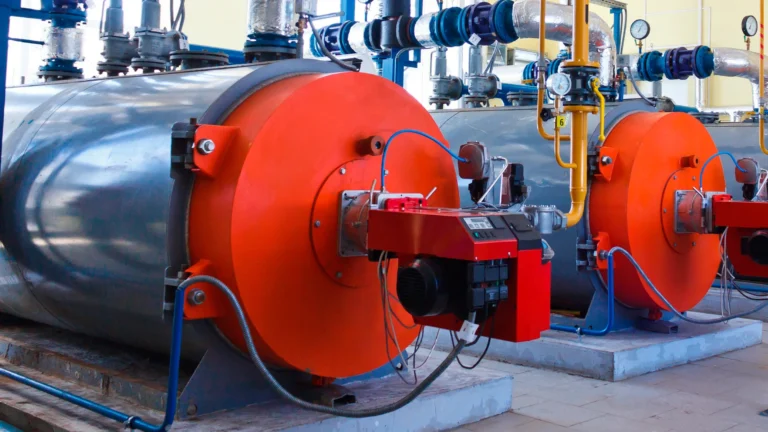
We service the commercial corridors across Baldwin, Garden City, Mineola, Westbury, Farmingdale, Bellmore, Seaford, Franklin Square, Rockville Centre, Merrick & Long Beach, diagnosing and repairing fire-tube boilers, water-tube boilers, cast iron sectional units, condensing boilers, and high-mass hydronic systems. Each boiler type has its own failure signatures, and our technicians read those signatures before they open a single access panel. That methodical approach is what separates a repair that holds through the heating season from one that recurs within weeks.
How We Diagnose a Failing Commercial Boiler
Diagnosis begins with the symptoms you report, but it rarely ends there. A boiler that short-cycles might point to an oversized unit, a faulty aquastat, scale buildup on heat transfer surfaces, or a circulator that is not moving water fast enough. We treat the reported complaint as a starting coordinate, then work systematically through the combustion side, the water side, and the control side of the system to isolate the true root cause.
Our standard diagnostic sequence follows a logical progression that prevents guesswork and reduces the chance of repeat failures:
- Combustion analysis: We measure flue gas composition, stack temperature, draft, and excess air to confirm the burner is firing within the manufacturer’s specified range. Poor combustion wastes fuel and produces dangerous carbon monoxide.
- Water-side inspection: We check system pressure, examine the expansion tank, test the low-water cutoff, and look for scale, sediment, or corrosion that restricts heat transfer across the exchanger.
- Control and safety verification: We test the aquastat, limit controls, pressure relief valve, flame sensor, ignition system, and gas valve to confirm every safety device operates at its designed threshold.
- Distribution evaluation: We confirm circulators, zone valves, and piping deliver heated water where it is needed without air locks or flow restrictions.
Only after we complete this sequence do we recommend a repair. This prevents the common and costly mistake of replacing a working component because it sits near the actual fault. When we quote a repair, we explain what failed, why it failed, and what will keep it from failing again.
Common Commercial Boiler Problems We Correct
Commercial boilers accumulate wear in predictable patterns, and recognizing those patterns lets us move quickly during an emergency call. Low system pressure is one of the most frequent complaints, and it usually traces back to a leak somewhere in the loop, a failing pressure-reducing valve, or a waterlogged expansion tank. We find the loss before we refill the system, because topping off a leaking boiler only masks the problem and accelerates internal corrosion.
Ignition and burner faults are another large category of our repair work. Dirty flame sensors, worn electrodes, clogged burner orifices, and failing gas valves all interrupt the firing cycle. On condensing boilers, we frequently find blocked condensate drains and fouled heat exchangers that reduce efficiency and eventually trip the unit offline. We clean, recalibrate, and replace these components to factory tolerances rather than approximating a fix.
Water quality issues cause damage that builds slowly and shows up as reduced output or noisy operation. Scale deposits on heat transfer surfaces force the boiler to work harder for the same output, while sediment in the bottom of the vessel creates hot spots that stress the metal. We address these through descaling, system flushing, and recommendations for water treatment that extends the life of the equipment.
Repair Versus Replacement: How We Advise
Not every failing boiler should be repaired, and we will tell you plainly when a replacement serves your building better than another round of repairs. A boiler that has lost significant efficiency due to a cracked heat exchanger, or one that requires increasingly frequent service calls, often costs more to keep running than to replace. We weigh the age of the unit, the availability of parts, the current efficiency rating, and the projected cost of upcoming repairs against the value of a new high-efficiency installation.
When replacement is the right path, we have the engineering capability to design and install the new system. We are leading providers in project design for commercial HVAC equipment on Long Island, and we represent the most trusted and innovative engineered products, designed for the specific requirements of each application. Our highly experienced Sales Engineers deliver customized solutions through mechanical design assistance, equipment cost analysis, and equipment supply to maximize energy efficiency. That means your repair conversation can transition seamlessly into a replacement plan without starting over with a new contractor.
Boiler Repair Across Different Commercial Settings
The way we repair a boiler depends heavily on the building it serves, because the tolerance for downtime and the operating demands vary widely. A few settings illustrate how we adapt our approach:
- Office and professional buildings: Here the priority is maintaining comfortable temperatures during business hours with minimal disruption. We schedule intensive repairs for off-hours when possible and keep temporary heat solutions available for extended outages.
- Restaurants and food service: Hot water and heat are tied directly to operations and health code compliance. We respond fast and verify that domestic hot water demand is restored alongside space heating.
- Multi-unit residential properties: Tenant safety and legal heating requirements drive our response. We restore heat quickly and document the repair for property managers who answer to tenants and local authorities.
- Retail and warehouse facilities: Large open spaces with high ceilings place heavy demands on distribution. We confirm not only that the boiler fires correctly but that heat reaches every zone evenly.
Across all of these environments, our goal is the same: restore reliable heat, confirm the system operates safely, and leave you with a boiler that performs the way it was engineered to. No matter the complexity of the job, we concentrate on your specific requirements to achieve your highest expectations.
Technical Specifications We Verify on Every Repair
A completed boiler repair is not finished until the measurements confirm correct operation. We document stack temperature and compare it to the expected range for the boiler type, because an excessively high stack temperature indicates fouled heat transfer surfaces. We verify that system pressure holds steady at the designed cold-fill and operating values, and we confirm the pressure relief valve lifts at its rated pressure and reseats cleanly.
On the combustion side, we confirm oxygen and carbon dioxide percentages fall within manufacturer tolerances and that carbon monoxide readings remain at safe levels. We check that the differential between the aquastat high and low settings matches the application, and that limit controls interrupt firing at their rated thresholds. These numbers give us objective proof that the repair returned the boiler to safe, efficient operation rather than merely getting it to light.
Why Long Island Businesses Call Luxaire HVAC Services, Inc.
We provide our clients with a wide range of HVAC contracting services, covering new construction as well as the remodeling of existing facilities, and that breadth informs how we handle boiler repair. A technician who understands full system design brings more insight to a single repair, because they see how the boiler interacts with distribution, controls, and the building envelope. From HVAC system design, installation, and logistics to essential upkeep and repair, we determine the best approach to optimize results.
As Long Island’s most trusted commercial and residential HVAC provider, Luxaire HVAC Services, Inc. serves businesses throughout Baldwin, Garden City, Mineola, Westbury, Farmingdale, Bellmore, Seaford, Franklin Square, Rockville Centre, Merrick & Long Beach with commercial boiler repair, maintenance, and replacement. When your heat fails, you need a contractor who diagnoses accurately the first time, repairs to specification, and stands behind the work. Contact us to schedule a diagnostic visit or to discuss a service plan that keeps your boiler running reliably through every heating season.